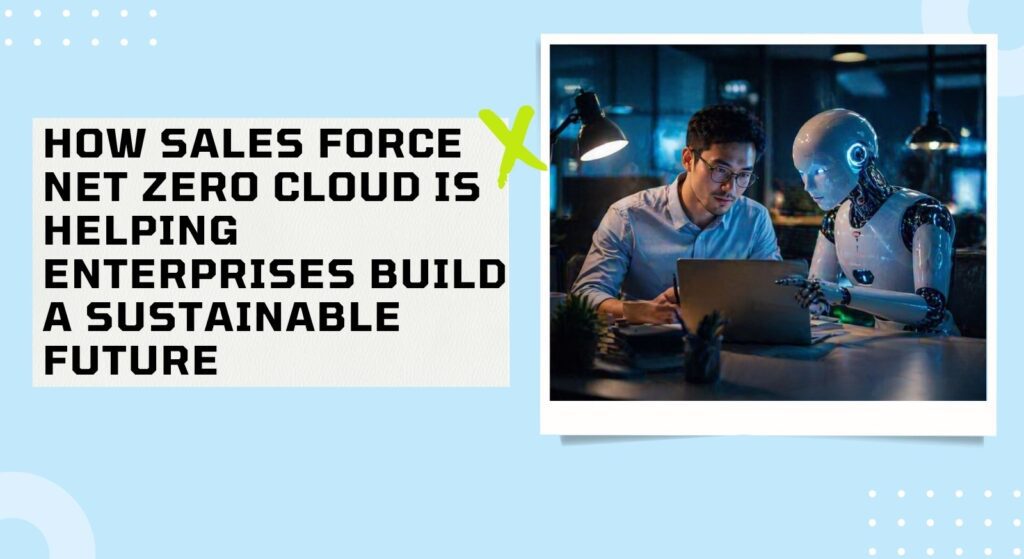
Now, sustainability is not merely a topic of discussion in the corporate world to include in the annual report of a firm, but it is becoming an absolute requirement. However, some companies continue using Excel spreadsheets or even lack any system for tracking and managing environmental performance at all.
Salesforce Net Zero Cloud seeks to solve this problem by integrating the process of managing the corresponding information within the existing Salesforce platform. By avoiding the need to introduce additional software, the solution allows making the management process more effective.
What Is Salesforce Net Zero Cloud?
Salesforce Net Zero Cloud is a sustainability management system for businesses developed natively by Salesforce. Formerly called Sustainability Cloud, it helps enterprises calculate and reduce their carbon footprints.
The proposed solution considers the quantification of greenhouse gases in three scopes according to the GHG Protocol:
- Scope 1 covers direct emissions from owned sources, such as burning fuels in vehicles and buildings.
- Scope 2 covers indirect emissions from energy purchases, including electricity, steam, heat, and refrigeration.
- Scope 3 is the most difficult to quantify, involving indirect emissions through the entire life cycle, from suppliers to transportation, commuting, and waste management.
Key features include data structure, emissions factors, reporting templates, and Salesforce sustainability integration.
Why Are Enterprises Replacing Spreadsheets?
According to Salesforce documentation on Trailhead, organizations managing environmental data manually can spend anywhere from 6 to 8 months collecting figures from just the previous fiscal year. By the time the data is ready, the next reporting cycle has already begun.
For publicly traded companies, that kind of lag is a compliance risk. For companies under the EU CSRD, exposure is higher, with around 50,000 companies required to report. Add California Climate Accountability Package requirements and a growing number of regional mandates, and the pressure to operationalize sustainability reporting becomes very real.
The core value of carbon tracking Salesforce delivers is automation. Rather than hunting for utility bills and supplier invoices once every quarter, data comes in constantly, and your team concentrates on doing something with the data.
Key Features That Matter
Net Zero Cloud is different because it brings together data centralization, automation, and AI to make sustainability reporting easier.
1. One Place for All Environmental Data
Net Zero Cloud functions as a single source of truth for emissions data. All energy consumption, travel, waste, and supplier emissions are accounted for in one place. Information can be added to the system via APIs, mass data uploads, or through the Intelligent Document Reader that automatically analyzes utility bills.
2. AI-Assisted Reporting via Agentforce
The platform integrates with Agentforce and the Salesforce AI layer to automate ESG report generation. It identifies relevant metrics, cross-references them against required reporting frameworks, and generates draft responses. For sustainability teams managing heavy workloads, this meaningfully reduces the manual effort tied to annual and quarterly disclosures.
3. Framework-Specific Report Builders
The ESG Salesforce reporting functionality includes pre-built report builders for CSRD, GRI, SASB, and CDP frameworks. Rather than interpreting each standard and figuring out how to map your data, the platform walks compliance teams through exactly what is needed. New frameworks are added as regulations change, including builders for California climate disclosure laws.
4. What-If Scenario Modeling
Net Zero Cloud can model emissions scenarios before decisions are made. In the case of a business analyzing going green in its energy sourcing, replacing its diesel fleet, or switching suppliers, the tool helps estimate the carbon footprint impact. This makes sustainability an actual decision factor rather than merely a reporting tool.
5. Executive Dashboards Built for Decision-Making
Leadership teams get dashboards that surface emissions trends, energy patterns, and target progress. The data quality is designed to be investor-grade, which means it holds up under third-party audits and financial filings.
Feature Overview
| Feature | What It Does | Who Benefits |
| Scope 1, 2, 3 Emissions Tracking | Centralizes all GHG data | Sustainability and finance teams |
| Agentforce AI Reporting | Automates ESG report drafting | Compliance and reporting teams |
| Framework Report Builders | Pre-built for CSRD, GRI, SASB, CDP | Legal and regulatory teams |
| What-If Scenario Modeling | Forecasts the emissions impact of decisions | C-suite and strategy teams |
| Supplier Data Integration | Extends tracking across the value chain | Procurement teams |
| CRM Analytics Dashboards | Executive-level emissions visibility | Leadership and investor relations |
How Accenture Uses It?
Accenture is one of the more well-documented enterprise deployments of Net Zero Cloud. The company created a central data storage platform for the firm’s environmental information across all its worldwide activities, utilizing the platform to generate a unified and uniform perspective of its carbon footprint. The purpose was to make the company responsible not only for its financial results but also for its sustainability performance.
This particular example deserves attention due to Accenture’s large-scale and complex supply chain. The fact that the platform performs at that level gives mid-to-large enterprises a reasonable benchmark for what is achievable.
The Role of Implementation Support
The implementation of enterprise sustainability software such as Net Zero Cloud is certainly no easy plug-and-play task for any business. ERP integration, facility management systems, and supplier information must all come together cleanly. Emission factors need proper mapping. Reporting frameworks need to be configured to match the actual business structure.
Here is where the Salesforce Consulting partner brings the most value. Implementation will not be a simple process of setting up the system because it will entail integrating data, processes, data quality, reporting guidelines, and other areas that need to be addressed for proper emissions reporting purposes.
A competent Salesforce consulting services provider with extensive experience in Salesforce implementation and sustainability can greatly speed up the process. Data structure, data quality and integration, user training, and other steps will be taken care of by the service to ensure reporting will already be prepared for any audit by the time needed.
Those who lack the capability to keep the platform updated on their own should consider using Salesforce managed services. An outsourced team will be responsible for updating the platform and maintaining its data quality according to changes in legislation.
It Is Bigger Than Compliance
There is a tendency to frame all of this around regulatory compliance, but that understates what is actually at stake. Companies building solid sustainability data infrastructure today are positioning themselves for a market where supply chain partners, institutional investors, and enterprise customers will increasingly require emissions transparency as a baseline condition.
Organizations that produce auditable, real-time environmental data gain an advantage in procurement, investor relations, and partnerships. Enterprise sustainability software embedded in operations, rather than in silos, makes that advantage lasting.
Turn Sustainability Goals Into Measurable Action
Salesforce continues to build out its Net Zero Cloud through enhanced regulatory functionality, deeper Agentforce automation, and Microsoft 365 integration, all centered around artificial intelligence and compliance. For businesses, ongoing development enables avoiding any system modifications as regulations change.
While most sustainability commitments falter not because of the intention but because there’s no infrastructure in place, those who are actually making strides towards becoming net zero consider their environmental data as seriously as their financial data.
Salesforce Net Zero Cloud offers precisely the necessary infrastructure for businesses to measure, report, and decide using actual data instead of guesswork. And if your business hasn’t yet automated the tracking of its environmental impact, you probably have no idea how expensive this approach can be.
FAQs
Q1. Does Salesforce Net Zero Cloud monitor Scope 3 emissions?
Ans. Yes. The monitoring of Scope 3 emissions is achieved through the use of supplier data integration and GHG Protocol emission factors, where suppliers can provide their data directly.
Q2. How does Net Zero Cloud connect with systems like SAP or Oracle?
Ans. It integrates via Salesforce APIs, MuleSoft, and supports data ingestion through document readers and CSV uploads for data migration.
Q3. Is Net Zero Cloud suitable for mid-market companies?
Ans. Yes, depending on regulatory exposure. Companies in EU supply chains or under CSRD pressure may benefit, and consulting partners can help assess fit.
Q4. Can Salesforce Net Zero Cloud generate CSRD-compliant reports automatically?
Ans. Net Zero Cloud offers pre-built CSRD report builders that map emissions data to disclosure requirements. Agentforce AI helps draft responses, reducing manual work.
Q5. How long does it take to implement Net Zero Cloud?
Ans. Typically 3–6 months for mid-to-large enterprises, depending on data complexity. The main effort lies in data integration and emissions mapping, not platform setup.

Director / CEO
Vishal Aggarwal is the Director/CEO at CRM Masters Infotech, with over 22 years of experience driving business growth through strategic ERP and CRM solutions. Specializing in Zoho and Salesforce, he helps businesses automate sales processes, improve efficiency, and achieve scalable growth with customer-focused, data-driven strategies. His expertise serves clients across industries such as manufacturing, retail, finance, real estate, and education, empowering organizations to optimize operations and maximize ROI.